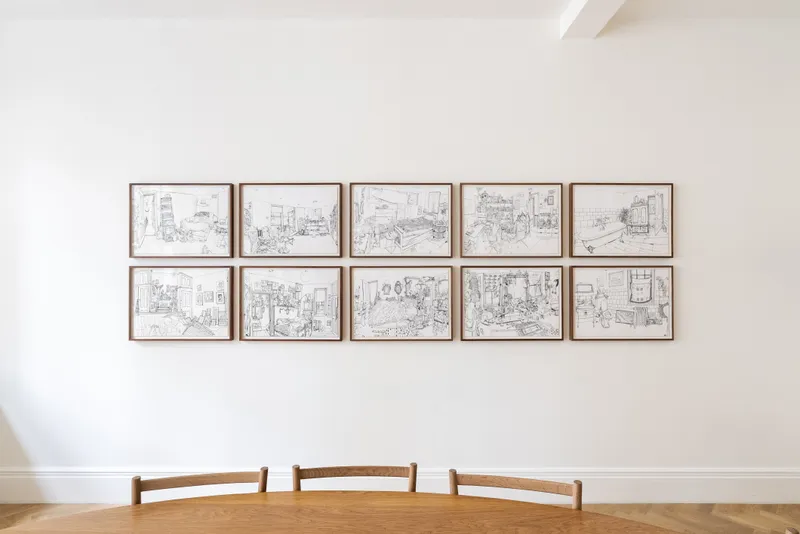
Lyndsey Ingram is pleased to present an exhibition of works by Ishbel Myerscough, Stay at Home, Save Lives, the artist’s first solo exhibition at the gallery. The exhibition centres on a series of ink drawings created in 2020 at the height of the Covid-19 pandemic, presented alongside more recent still life and portrait paintings. Together, these works reflect on the psychological strain of isolation, tracing the quiet tensions of the pandemic years, whilst also acknowledging how life continued after this period, as the steady hum of domesticity returned to Myerscough’s home, which also functions as her studio.
During lockdown, the demands of running a household and caring for her family’s wellbeing left little time or emotional space for Myerscough’s artistic practice. Drawing, however, emerged as a more accessible means of expression and served as a vital creative outlet. With tight government restrictions that limited contact with the outside world, Myerscough meticulously recorded her immediate surroundings, individually drawing every corner of her family’s London home.
Myerscough’s domestic drawings embody a personal and familial presence that allows them to function almost as portraits of those inhabiting the home, despite no people appearing in the series. The two drawings of Bella’s bedroom, for example, capture a fleeting stage of adolescence; amongst the teddies, dolls, and childhood memorabilia are signs of teenage reinvention and self-expression. In this imagery, Myerscough captures a life caught in transition, poised between growth and change, yet suspended by uncertainty and limitation.
On returning to oil painting, Myerscough found herself instinctively drawn back to the human figure. She began to depict her subjects in states of quiet introspection: sleeping, reading, or lost in thought. A particularly striking work is the portrait of her son Fraser, presented lying in his underwear across the family’s cherry wood kitchen table. His pale, almost translucent skin sharply contrasts with the deep blue background, and his vacant gaze confers a haunting stillness that is both intimate and unsettling. Clearly evoking classical and religious iconography, the image stands as Myerscough’s profound response to the emotional toll of the pandemic on the young people closest to her. In terms of its narrow, dramatically foreshortened composition, the painting is also eerily reminiscent of Andrea Mantegna’s ‘Lamentation of Christ’. Though Fraser’s body shows no physical illness, his melancholic presence, stripped of distraction, reflects the constrained, listless reality experienced by the younger generation during the pandemic.
The isolation of lockdown also sparked a subtle yet obsessive fixation on health and personal wellbeing. Myerscough captures this shift in a series of small-scale still life paintings that elevate everyday objects into quiet symbols of collective anxiety. A worn bar of soap, a neatly arranged selection of vitamins, and an endless supply of painkillers become charged with meaning, reflecting how cleanliness and self-care became all-consuming and have remained public concerns.
Capturing both the intimate rhythms of domestic existence and the psychological weight of Covid and lockdown, Myerscough’s exhibition tells a nuanced story of the pandemic and beyond where both the private and universal intersect.
